It is not dead skin: why the rough spot on your sole now has neighbors
It is a wart, and a wart is a skin infection, which is why they multiply. Here is the real reason one rough spot becomes two, then several, and the one thing people do every week that moves it along.
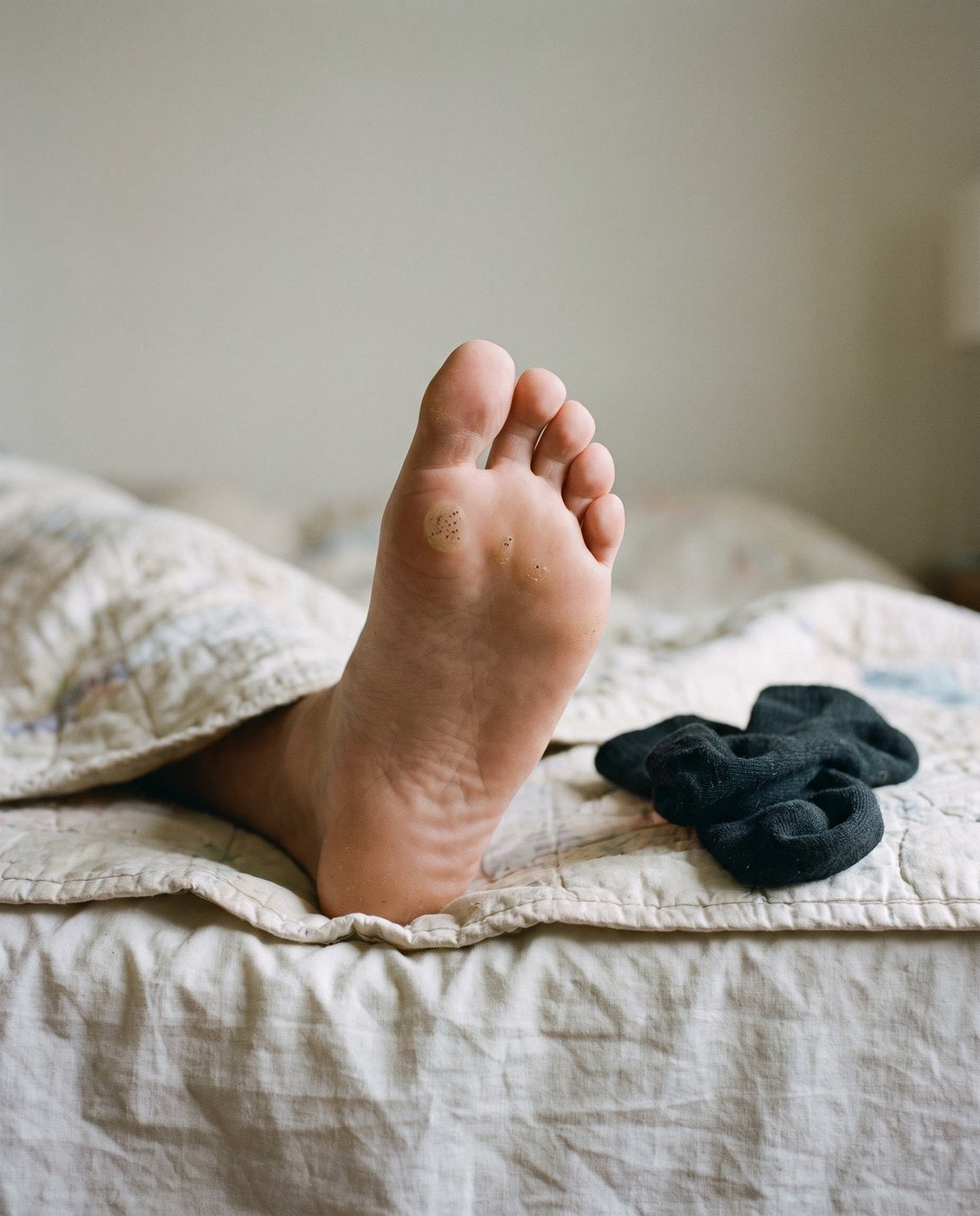
It usually starts as one small, rough spot. On the ball of the foot, on the heel, or under a toe.
You take it for dead skin. You file it flat or pick at it after a shower, and you forget about it.
Then it comes back. And one day there is a second one, right next to the first.
“I thought it was just a build up of dead skin. Now I think I might have one on 2 other toes”
If that is where you are, this page is for you. What you have is not dead skin, and the thing you have been doing to keep it smooth is the reason there are more.
To actually beat them you need to go from the inside, and that is what bee resin is for. First, how one became several.
You have probably given it three or four names by now
Dead skin, from being on your feet all day. A callus. A corn. A splinter that never came out.
“I just assumed it’s a callus or a corn from constant walking”
So you treated it like those things. Foot cream. A pumice stone in the shower. A foot file, or a blade. Thicker socks, so it hurt less.
It never felt worth a doctor.
And all the while, the count has been going up. One, then two beside it. Then one on the heel. Then the other foot. One person watched it for two years: “it progressed from one little spot to covering nearly the entire ball of my foot.”
That is the part that sits in the back of your mind. Not the spot itself. Where it is going, who might see it, and whether the people you share a bathroom with are next.
“I never ever go barefoot, the thought of someone seeing my foot makes me feel sick”
One person wrote down the rule at home:
“socks at ALL TIMES; they only come off to change socks or to shower”
There is one kind of thing on skin that multiplies like this, and it is not dead skin. It is a wart.
Why nothing you tried has worked
Foot cream and soaking. They soften skin. This is not skin that needs softening, so nothing changed.
Filing it flat, or picking at it after a shower. It looks better for a week. Then it grows back, rougher, and often with a new one beside it. This is the important one, and the reason is below.
A pumice stone or a blade. The same as filing, over a wider patch of skin, and then the same stone goes over the rest of the foot.
Leaving it alone. It stayed, for months or years, and then there were more.
Each of these fails for the same reason, and none of it is your fault. You were looking after something nobody had named for you.
What it actually is
A rough spot that comes back after you file it, and brings new ones up beside it, is a wart.
A wart is not dead skin. It is a skin infection, and it lives in the top layer of your skin: in the spot, and in the skin around the spot that looks completely normal.
You can check in a minute.
Three checks, one minute, good light
Now the part that explains the count. The infection spreads through small breaks in the skin. Every time a wart is filed, shaved or picked, the skin opens, and the infection is carried into the skin beside it, or across the sole on the stone.
That is how one became several. You did not catch it five times. You had it once, and keeping it smooth moved it along.
So the first thing is simple, and it is free: stop filing it.
Why your body has not cleared it
You get over a cold in a few days. So why is this still here after a year?
Because your body cannot see it. This infection stays in the outer layer of skin. It never enters the blood, it kills no cells, and it causes no redness or swelling. Nothing ever raises the alarm.
There is nothing wrong with your immune system. It has not been told.
When it does notice, warts go, and sometimes all of them go in the same week. People are baffled when it happens to them. One wrote: “I went to sleep one night, and they were gone with no treatment.”
That is not luck. That is the body finally seeing it. And it is the only thing that really ends a wart, because it clears the infection from all of the skin, not one spot.
What reaches all of it at once
A file reaches the spot. So does a pad from the pharmacy, and so does a freeze at the clinic. If you have already tried either, you will have seen it come back: they remove the spot you can see, and what grows it is in the skin around it.
A capsule reaches all of your skin. You swallow it, its compounds are in your blood within the hour, and blood goes everywhere your skin is: the spots you can see, the skin between them, and the place the next one was going to come up.
The capsule that has been tested for this is propolis, the resin bees line the hive with to keep infection out of a warm, crowded space. You may know it as bee resin. It does not attack the wart. It strengthens the body's own defense against an infection living in the skin.

Moskira Propolis is that capsule: pure propolis, 500 mg, one a day. One bottle is three months.
What the trial found
In a trial, 135 people with warts were put in three groups. One group took a propolis capsule every day. One took echinacea, the best-known immune herb. One took a capsule with nothing in it. It ran for three months.
On propolis, about three in four of the people with common or flat warts were clear at the end. Both other groups did worse.
The capsule in that trial was 500 mg, once a day, for three months. That is exactly what one bottle of Moskira Propolis is.
Is mine even a wart?
Use the three checks above: the skin lines, the black dots, the squeeze. A spot that grows back after filing and has neighbors is very likely a wart.
If it bleeds without being touched, changes color, grows fast, or you are simply not sure, show it to a doctor. That is not wasting anyone's time.
A capsule, for something on the bottom of my foot?
It sounds backwards until you know where the infection is. It is not only in the spot. It is in the skin around it, where nothing you put on the spot will reach. Blood reaches all of it.
Can I not just keep it filed down?
You can, and it will feel smoother for a week at a time. But filing is how one became several. The more often you do it, the more skin you open.
How long does it take?
Three months, the length of the trial, and there is nothing to see in the first few weeks. So here is a plan for the three months: one photo a week, and what to look for.
The three months, and what to look for
Is it safe for me?
It is propolis and nothing else. It is for adults. Do not take it if you are allergic to bees or bee products. If you are pregnant or nursing, ask a doctor first.
What it costs, next to the alternatives
If it keeps multiplying, the next stop is a podiatrist or a dermatologist. Having one wart frozen there costs people $250 and more, by their own accounts, and it is rarely one visit.
One bottle of Moskira Propolis is the full three months: 90 capsules, one a day. It is $34.99, with free shipping.
Take the whole bottle. If the spots are still there after three months, write to us within 100 days of delivery and we refund you. You do not send anything back.
The three-month course
You can keep filing it flat on Sunday nights and counting the new ones.
Or you can put the file away, take one capsule a day for three months, and get your money back if they are still there.
Sources
- Zedan H, Hofny ERM, Ismail SA. Propolis as an alternative treatment for cutaneous warts. International Journal of Dermatology 2009;48(11):1246-1249.
- Stanley MA. Epithelial cell responses to infection with human papillomavirus. Clinical Microbiology Reviews 2012;25(2):215-222.
- Ring wart after cryotherapy: Loyola University dermatology atlas; Patient Care, How to cope with ring wart.
- Bruggink SC et al. Cryotherapy with liquid nitrogen versus topical salicylic acid application for cutaneous warts in primary care: randomized controlled trial. CMAJ 2010;182(15):1624-1630.
- Autoinoculation by picking, biting and shaving: Practical Dermatology, November 2021.
- Gardana C et al. Journal of Chromatography B 2007 (propolis compounds in blood). Brätter C et al. 1999 (immune signals at 500 mg a day). Shimizu T et al. 2011 (propolis by mouth against a skin infection, in mice).
- Telling a wart from a callus: University of Utah, dermatology teaching pages, Diagnosis of warts. A wart on the sole growing inward under a callus: Mayo Clinic, Plantar warts.